Backpack Exchange review
Last reviewed:
FlixoCrypt rating
Key facts
| Type | CEX (Exchanges (CEX)) |
|---|---|
| Trading fees | Maker 0.02% · Taker 0.05% |
| Withdrawal | Variable by asset |
| Free to use | Yes |
| KYC required | No |
| Regulated | No / limited |
| Supported assets | 250+ assets |
| Country availability | Global |
| Restricted regions | None listed |
| Affiliate commission | Not publicly listed · Not publicly listed (PLACEHOLDER — pending affiliate approval) |
| FlixoCrypt rating | 4.2 / 5 |
| Best for | Solana ecosystem traders seeking fast, low-friction trading without custody intermediaries. |
| Last verified | 2026-06-30 |
Overview
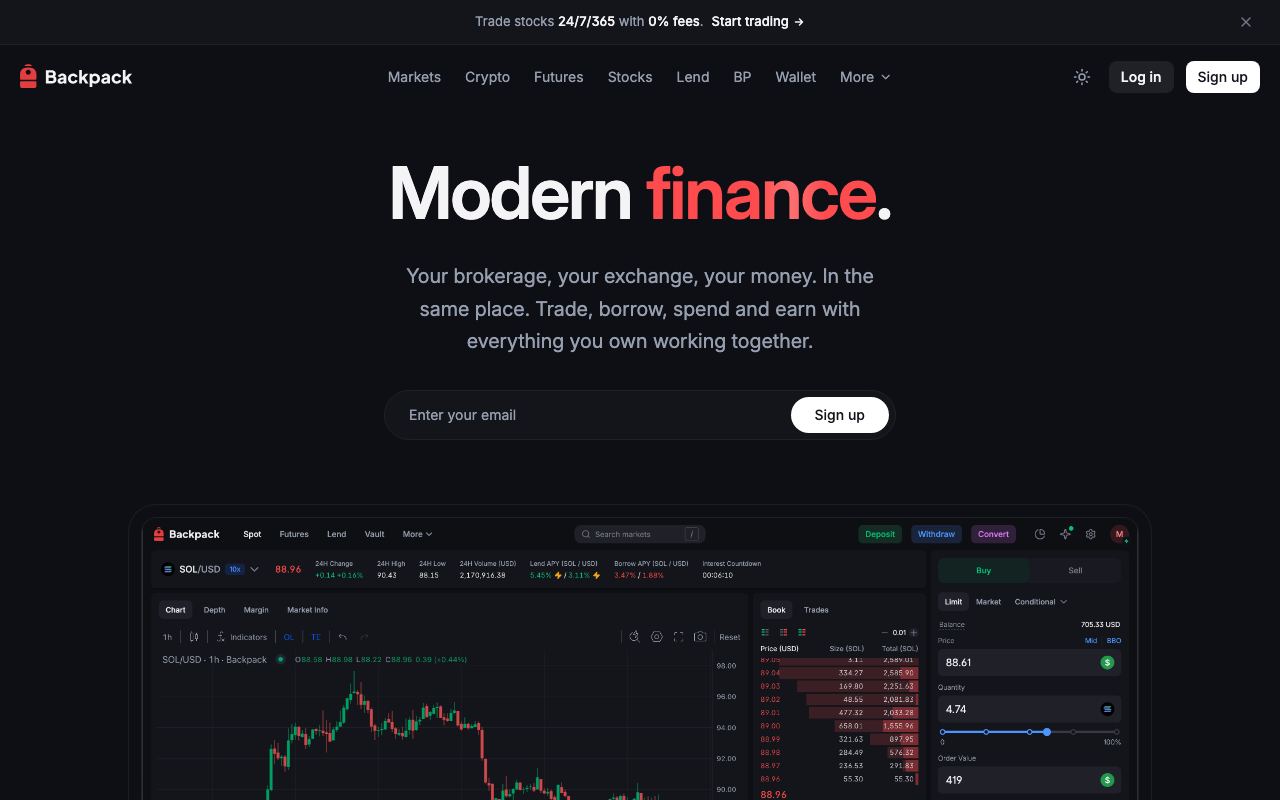
Backpack Exchange is a non-custodial cryptocurrency trading platform optimised for the Solana blockchain ecosystem. Unlike traditional centralised exchanges that hold user funds in company-controlled wallets, Backpack operates on a model where users retain direct control of their assets during trading through smart-contract-based settlement. The exchange is built on Solana's infrastructure, enabling transaction speeds measured in milliseconds and settlement finality within seconds rather than minutes. The platform's fee structure is competitive: maker fees of 0.02% and taker fees of 0.05% place it among the lowest-cost options in the market. Withdrawal fees vary by asset but are generally minimal on Solana due to its low base transaction costs. Backpack does not require Know Your Customer (KYC) verification, allowing pseudonymous trading; however, this also means the exchange operates without regulatory licensing or oversight from traditional financial authorities. Backpack supports approximately 250 tokens, the vast majority of which are Solana-based or wrapped versions of assets bridged to Solana. The platform has gained prominence since 2024 as institutional and retail traders seeking Solana exposure have grown, particularly following the blockchain's recovery from its 2022 collapse. Major institutional participants, including Jump Crypto (a subsidiary of Alameda competitor Jump Trading), have been backers of the platform. The exchange has not disclosed any major security breaches or custody losses. The exchange is most suitable for traders already holding Solana ecosystem assets and seeking rapid, low-cost execution without trusting a centralised entity with their private keys. For users requiring broad cross-chain support, regulatory certainty, or deep liquidity in Bitcoin and Ethereum pairs, Backpack's narrower asset range and non-regulated status may be disadvantageous. Compared to Binance or Coinbase, Backpack sacrifices breadth and regulatory credibility for speed and lower fees within its native ecosystem.
Availability
Backpack Exchange is available in: Global. Always confirm availability for your country on the official site, as regional support changes. Availability, regulation and tax treatment vary by country. Check your local laws before trading, and confirm current details on the official site. Regional note — India: Indian residents face 30% tax on crypto gains and 1% TDS on transactions above ₹50,000 per the Finance Act 2022.
Pros
- Solana-native exchange with fast settlement and low latency
- Non-custodial trading model reduces counterparty risk
- Competitive maker and taker fees at 0.02% and 0.05% respectively
Cons
- Limited to primarily Solana-based tokens; fewer cross-chain assets than major CEXs
- Smaller liquidity pools compared to established exchanges may result in wider spreads
- No regulatory oversight or formal compliance framework in place
Who it is for
- Best for: Solana ecosystem traders seeking fast, low-friction trading without custody intermediaries..
- Avoid if: You require regulatory protections, multi-chain asset support, or high liquidity across a broad range of trading pairs..
Verdict
Backpack Exchange is a legitimate, fast-growing non-custodial CEX tailored to Solana traders. Its competitive fees and non-custodial model appeal to users prioritising sovereignty and low latency, but its concentration on Solana-based assets and lack of formal regulation limit its appeal to mainstream users. It is best viewed as a specialist venue for Solana ecosystem activity rather than a general-purpose exchange.
User reviews
Real reader reviews — separate from FlixoCrypt's own editorial rating above. Every submission is moderated before it appears here.
Loading reviews…
Write a review
Get notified if Backpack Exchange has a security incident
Backpack Exchange FAQ
What is Backpack Exchange? +
Backpack Exchange is a non-custodial cryptocurrency trading platform optimised for the Solana blockchain ecosystem. Unlike traditional centralised exchanges that hold user funds in company-controlled wallets, Backpack operates on a model where users retain direct control of their assets during trading through smart-contract-based settlement. The exchange is built on Solana's infrastructure, enabling transaction speeds measured in milliseconds and settlement finality within seconds rather than minutes. The platform's fee structure is competitive: maker fees of 0.02% and taker fees of 0.05% place it among the lowest-cost options in the market. Withdrawal fees vary by asset but are generally minimal on Solana due to its low base transaction costs. Backpack does not require Know Your Customer (KYC) verification, allowing pseudonymous trading; however, this also means the exchange operates without regulatory licensing or oversight from traditional financial authorities. Backpack supports approximately 250 tokens, the vast majority of which are Solana-based or wrapped versions of assets bridged to Solana. The platform has gained prominence since 2024 as institutional and retail traders seeking Solana exposure have grown, particularly following the blockchain's recovery from its 2022 collapse. Major institutional participants, including Jump Crypto (a subsidiary of Alameda competitor Jump Trading), have been backers of the platform. The exchange has not disclosed any major security breaches or custody losses. The exchange is most suitable for traders already holding Solana ecosystem assets and seeking rapid, low-cost execution without trusting a centralised entity with their private keys. For users requiring broad cross-chain support, regulatory certainty, or deep liquidity in Bitcoin and Ethereum pairs, Backpack's narrower asset range and non-regulated status may be disadvantageous. Compared to Binance or Coinbase, Backpack sacrifices breadth and regulatory credibility for speed and lower fees within its native ecosystem.
Is Backpack Exchange safe? +
Backpack Exchange is lightly regulated or non-custodial. No major custody breach on record. As with any platform, use strong security and only hold what you need on it.
Does Backpack Exchange require KYC? +
No — KYC is not required (non-custodial or minimal verification), which shifts custody and compliance responsibility to you.
What are Backpack Exchange's fees? +
Backpack Exchange fees: maker 0.02%, taker 0.05%; withdrawals: Variable by asset. Always confirm current fees on the official site, as crypto fees change often.
Is Backpack Exchange available in my country? +
Available globally, with some regional restrictions. Availability, regulation and tax treatment vary by country. Check your local laws before trading, and confirm current details on the official site. Regional note — India: Indian residents face 30% tax on crypto gains and 1% TDS on transactions above ₹50,000 per the Finance Act 2022.
What is Backpack Exchange best for? +
Solana ecosystem traders seeking fast, low-friction trading without custody intermediaries..
When should you avoid Backpack Exchange? +
Avoid Backpack Exchange if: You require regulatory protections, multi-chain asset support, or high liquidity across a broad range of trading pairs..
What are the main pros and cons of Backpack Exchange? +
Pros: Solana-native exchange with fast settlement and low latency; Non-custodial trading model reduces counterparty risk; Competitive maker and taker fees at 0.02% and 0.05% respectively. Cons: Limited to primarily Solana-based tokens; fewer cross-chain assets than major CEXs; Smaller liquidity pools compared to established exchanges may result in wider spreads; No regulatory oversight or formal compliance framework in place.
Is Backpack Exchange regulated? +
No / limited. See the official site for current licensing.
When was this Backpack Exchange review last verified? +
This review was last verified on 2026-06-30 against the official site.
Reviewed by Arjun Mehta
Editorial lead overseeing FlixoCrypt's research, sourcing and verification process
Last verified:
Sources
- Backpack Exchange — official site — verified