SynFutures review
Last reviewed:
FlixoCrypt rating
Key facts
| Type | Permissionless derivatives trading protocol (DeFi Tools) |
|---|---|
| Trading fees | Maker 0.02% · Taker 0.05% |
| Withdrawal | Network-dependent |
| Free to use | Yes |
| KYC required | No |
| Regulated | No / limited |
| Supported assets | 200+ assets |
| Country availability | Global |
| Restricted regions | None listed |
| Affiliate commission | none · Not publicly listed (PLACEHOLDER — pending affiliate approval) |
| FlixoCrypt rating | 3.6 / 5 |
| Best for | Traders seeking permission-free access to emerging derivative pairs and users who value decentralised contract listing mechanics. |
| Last verified | 2026-08-17 |
Overview
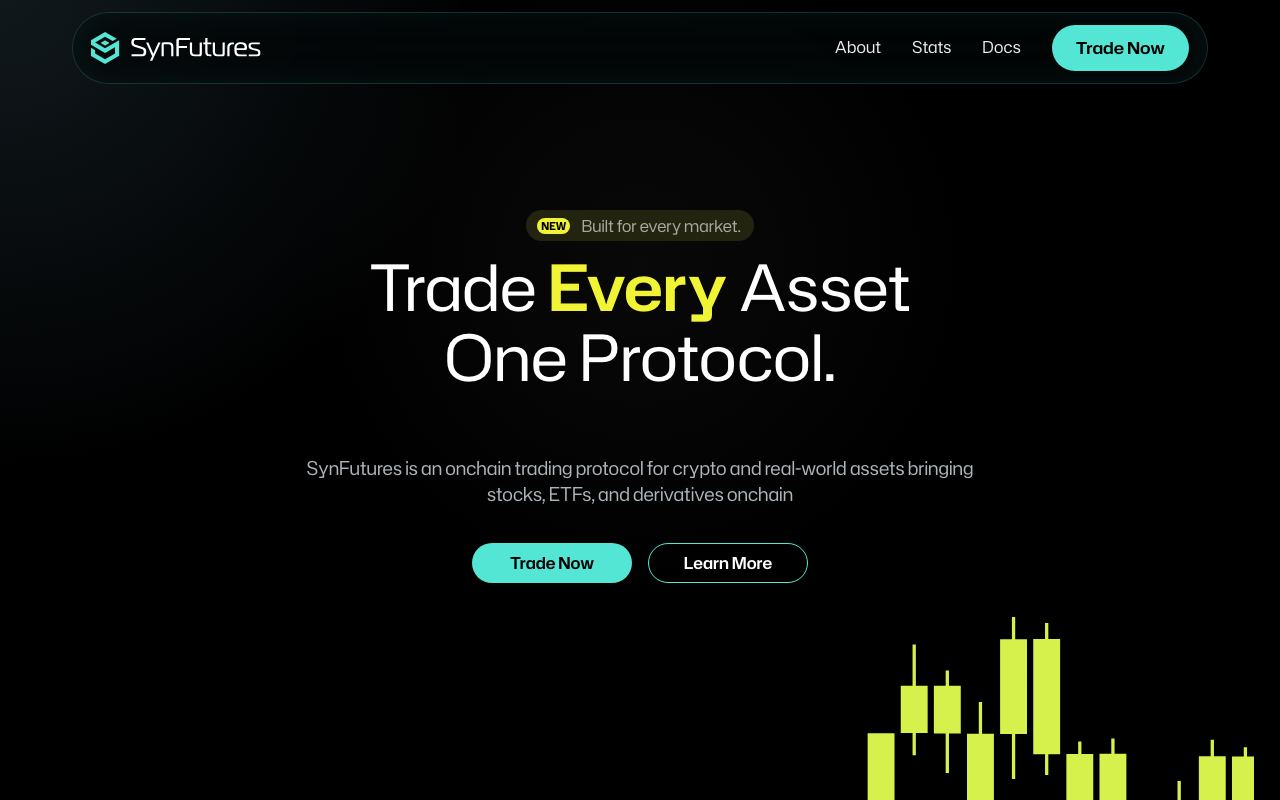
SynFutures is a permissionless derivatives trading protocol that enables users to trade perpetual futures contracts without requiring approval from a centralised authority to list new pairs. The protocol uses a single-token listing model, meaning any user can propose and activate a new derivative contract subject to minimal configuration, accelerating the pace at which emerging assets gain futures exposure. Trading fees are competitive at 0.02% maker and 0.05% taker, matching the rates of leading centralised derivatives exchanges. The platform operates entirely on-chain as a DeFi protocol, meaning users retain self-custody of collateral and interact directly with smart contracts via Web3 wallets. SynFutures has been listed on major centralised exchanges including Binance, Bitget, BingX, Bybit, and Upbit, indicating market confidence and liquidity provision from institutional market makers. No regulatory oversight applies to the protocol itself, consistent with decentralised finance architecture. The permissionless design is a double-edged sword: it enables rapid pair proliferation and reduces barriers to listing novel tokens, but also fragments liquidity across many pairs. Users unfamiliar with leverage trading and liquidation mechanics face heightened risk; the protocol offers no insurance or bankruptcy protection. SynFutures suits experienced derivatives traders seeking exposure to emerging tokens via decentralised infrastructure and those who value the ability to create custom derivative markets. Mainstream users expecting the polish, insurance, and institutional custody of regulated exchanges will find the protocol immature by comparison.
Availability
SynFutures is available in: Global. Always confirm availability for your country on the official site, as regional support changes. Availability, regulation and tax treatment vary by country. Check your local laws before trading, and confirm current details on the official site. Regional note — India: Indian residents face 30% tax on crypto gains and 1% TDS on transactions above ₹50,000 per the Finance Act 2022.
Pros
- Permissionless pair creation allows users to list new derivatives contracts without protocol governance, increasing liquidity variety
- Single-token listing model reduces friction compared to multi-collateral systems on traditional perp DEXs
- Low trading fees (0.02% maker, 0.05% taker) comparable to centralised derivatives exchanges
Cons
- Liquidity fragmentation due to permissionless design may result in wider spreads on lower-volume pairs
- Smart contract risk inherent to DeFi protocols; derivatives protocols carry higher leverage-related liquidation risks
- Limited mainstream adoption and brand recognition versus established perps venues like dYdX or Hyperliquid
Who it is for
- Best for: Traders seeking permission-free access to emerging derivative pairs and users who value decentralised contract listing mechanics..
- Avoid if: You prioritise deep liquidity, regulatory certainty, or insured custodial safeguards typical of institutional-grade derivatives platforms..
Verdict
SynFutures addresses a genuine market demand for permissionless derivatives infrastructure, offering low fees and rapid pair creation. However, liquidity fragmentation and the inherent risks of leverage trading in DeFi limit its appeal to experienced traders only.
User reviews
Real reader reviews — separate from FlixoCrypt's own editorial rating above. Every submission is moderated before it appears here.
Loading reviews…
Write a review
Get notified if SynFutures has a security incident
SynFutures FAQ
What is SynFutures? +
SynFutures is a permissionless derivatives trading protocol that enables users to trade perpetual futures contracts without requiring approval from a centralised authority to list new pairs. The protocol uses a single-token listing model, meaning any user can propose and activate a new derivative contract subject to minimal configuration, accelerating the pace at which emerging assets gain futures exposure. Trading fees are competitive at 0.02% maker and 0.05% taker, matching the rates of leading centralised derivatives exchanges. The platform operates entirely on-chain as a DeFi protocol, meaning users retain self-custody of collateral and interact directly with smart contracts via Web3 wallets. SynFutures has been listed on major centralised exchanges including Binance, Bitget, BingX, Bybit, and Upbit, indicating market confidence and liquidity provision from institutional market makers. No regulatory oversight applies to the protocol itself, consistent with decentralised finance architecture. The permissionless design is a double-edged sword: it enables rapid pair proliferation and reduces barriers to listing novel tokens, but also fragments liquidity across many pairs. Users unfamiliar with leverage trading and liquidation mechanics face heightened risk; the protocol offers no insurance or bankruptcy protection. SynFutures suits experienced derivatives traders seeking exposure to emerging tokens via decentralised infrastructure and those who value the ability to create custom derivative markets. Mainstream users expecting the polish, insurance, and institutional custody of regulated exchanges will find the protocol immature by comparison.
Is SynFutures safe? +
SynFutures is lightly regulated or non-custodial. No major custody breach on record. As with any platform, use strong security and only hold what you need on it.
Does SynFutures require KYC? +
No — KYC is not required (non-custodial or minimal verification), which shifts custody and compliance responsibility to you.
What are SynFutures's fees? +
SynFutures fees: maker 0.02%, taker 0.05%; withdrawals: Network-dependent. Always confirm current fees on the official site, as crypto fees change often.
Is SynFutures available in my country? +
Available globally, with some regional restrictions. Availability, regulation and tax treatment vary by country. Check your local laws before trading, and confirm current details on the official site. Regional note — India: Indian residents face 30% tax on crypto gains and 1% TDS on transactions above ₹50,000 per the Finance Act 2022.
What is SynFutures best for? +
Traders seeking permission-free access to emerging derivative pairs and users who value decentralised contract listing mechanics..
When should you avoid SynFutures? +
Avoid SynFutures if: You prioritise deep liquidity, regulatory certainty, or insured custodial safeguards typical of institutional-grade derivatives platforms..
What are the main pros and cons of SynFutures? +
Pros: Permissionless pair creation allows users to list new derivatives contracts without protocol governance, increasing liquidity variety; Single-token listing model reduces friction compared to multi-collateral systems on traditional perp DEXs; Low trading fees (0.02% maker, 0.05% taker) comparable to centralised derivatives exchanges. Cons: Liquidity fragmentation due to permissionless design may result in wider spreads on lower-volume pairs; Smart contract risk inherent to DeFi protocols; derivatives protocols carry higher leverage-related liquidation risks; Limited mainstream adoption and brand recognition versus established perps venues like dYdX or Hyperliquid.
Is SynFutures regulated? +
No / limited. See the official site for current licensing.
When was this SynFutures review last verified? +
This review was last verified on 2026-08-17 against the official site.
Reviewed by Arjun Mehta
Editorial lead overseeing FlixoCrypt's research, sourcing and verification process
Last verified:
Sources
- SynFutures — official site — verified