Gram (The Open Network) review
Last reviewed:
FlixoCrypt rating
Key facts
| Type | Blockchain platform and native token (DeFi Tools) |
|---|---|
| Trading fees | Maker N/A · Taker N/A |
| Withdrawal | N/A |
| Free to use | Yes |
| KYC required | No |
| Regulated | No / limited |
| Supported assets | — |
| Country availability | Global |
| Restricted regions | None listed |
| Affiliate commission | none · Not applicable (PLACEHOLDER — pending affiliate approval) |
| FlixoCrypt rating | 3.5 / 5 |
| Best for | Users seeking ultra-fast payments and Telegram-native blockchain interaction without custodial intermediaries. |
| Last verified | 2026-07-05 |
Overview
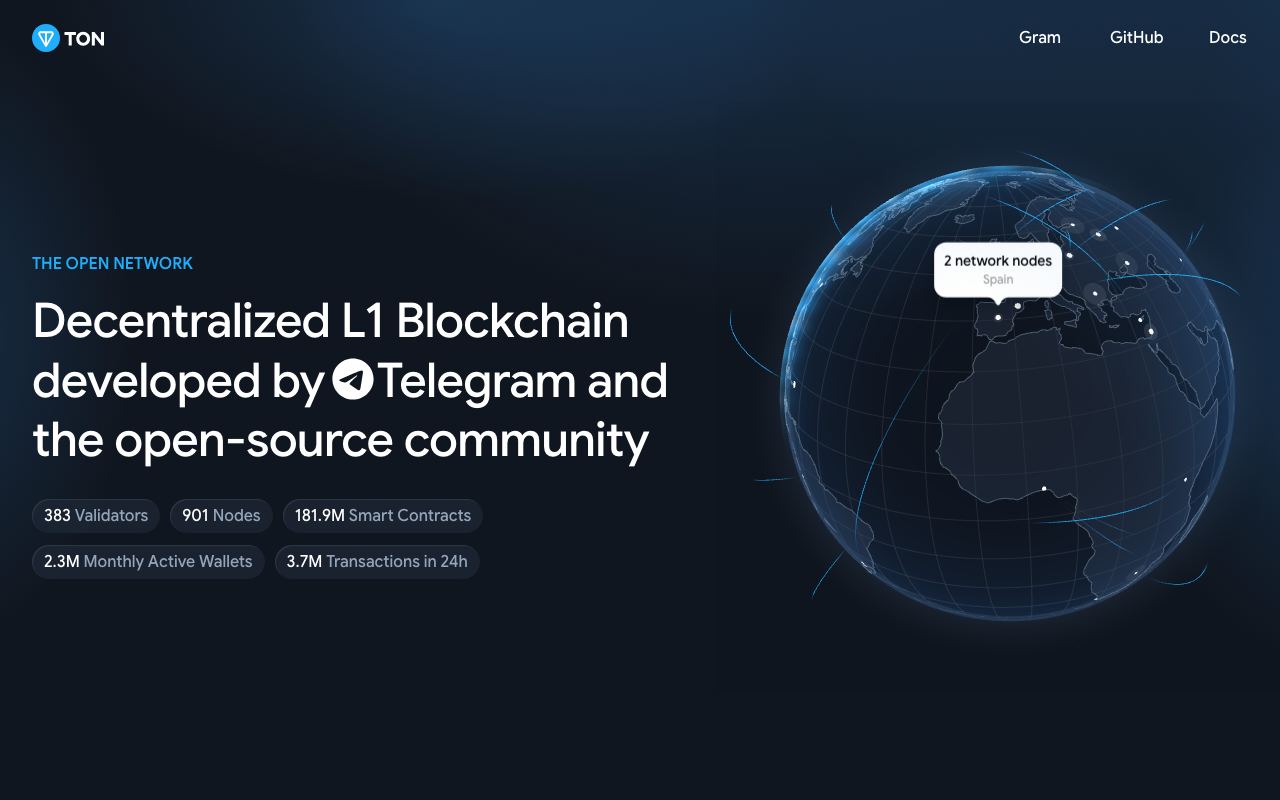
Gram is the native token of The Open Network (TON), a fully decentralised blockchain developed by Telegram. It powers transaction fees, validator staking, and smart contract execution on the network. TON was designed to handle mass adoption through Telegram's 900-million-user base, offering subsecond transaction finality and near-zero fees. The blockchain uses a Proof-of-Stake consensus model with no pre-mine or institutional allocation; the original Gram token was initially distributed to Telegram users via blockchain-based wallets. Transactions cost microscopically small amounts, and the network can process hundreds of thousands of transactions per second across multiple shardchains. Gram operates without a traditional central authority. Validators earn rewards from transaction fees and block rewards, incentivising network participation. The ecosystem includes DEXs, NFT marketplaces, and payment applications, though adoption trails Ethereum and Solana significantly. Regulatory clarity remains ambiguous: some exchanges list Gram, whilst others have delisted it due to Telegram's complex geopolitical status and historical regulatory scrutiny. The token is tradeable on major exchanges but trading volume and price discovery can be volatile. TON differs from conventional layer-2 solutions by operating as a fully independent chain rather than settling to another blockchain. Its primary advantage is frictionless Telegram integration; users can send Gram and interact with smart contracts directly within Telegram chats. However, the developer community remains smaller than Ethereum or Solana, resulting in fewer audited applications and less institutional adoption. Gas fees are negligible even during congestion, making it economical for micropayments and high-frequency transactions. The lack of regulatory endorsement in major jurisdictions and limited DeFi depth remain material limitations for institutional capital allocation. Gram's appeal is strongest for payment-centric and Telegram-native use cases. Traditional DeFi players, institutional treasury management, and applications requiring deep liquidity pools will likely remain anchored to Ethereum or other more established chains. The platform's openness and low costs make it excellent for emerging markets and unbanked populations, but the nascent tooling landscape requires caution for sophisticated trading or hedging strategies.
Availability
Gram (The Open Network) is available in: Global. Always confirm availability for your country on the official site, as regional support changes. Availability, regulation and tax treatment vary by country. Check your local laws before trading, and confirm current details on the official site. Regional note — India: Indian residents face 30% tax on crypto gains and 1% TDS on transactions above ₹50,000 per the Finance Act 2022.
Pros
- Extremely fast and low-cost transactions with sub-second finality
- Native integration with Telegram, enabling seamless blockchain access for 900+ million users
- Fully decentralised validator network with no institutional gatekeepers
Cons
- Significantly smaller ecosystem and developer community compared to Ethereum or Solana
- Regulatory uncertainty in some jurisdictions due to Telegram's geopolitical position
- Limited DeFi primitives and third-party tool integration relative to mature L1 blockchains
Who it is for
- Best for: Users seeking ultra-fast payments and Telegram-native blockchain interaction without custodial intermediaries..
- Avoid if: You require extensive DeFi options, institutional regulatory clarity, or established developer communities..
Verdict
Gram is a legitimate, fast, and low-cost blockchain native to Telegram with real adoption in payments and simple transfers. Its Telegram integration and subsecond finality are genuine technical strengths. However, regulatory uncertainty, a smaller DeFi ecosystem, and limited institutional endorsement restrict its appeal outside niche use cases. Suitable only for users comfortable with emerging infrastructure and willing to forgo deep liquidity or regulatory assurance.
User reviews
Real reader reviews — separate from FlixoCrypt's own editorial rating above. Every submission is moderated before it appears here.
Loading reviews…
Write a review
Get notified if Gram (The Open Network) has a security incident
Gram (The Open Network) FAQ
What is Gram (The Open Network)? +
Gram is the native token of The Open Network (TON), a fully decentralised blockchain developed by Telegram. It powers transaction fees, validator staking, and smart contract execution on the network. TON was designed to handle mass adoption through Telegram's 900-million-user base, offering subsecond transaction finality and near-zero fees. The blockchain uses a Proof-of-Stake consensus model with no pre-mine or institutional allocation; the original Gram token was initially distributed to Telegram users via blockchain-based wallets. Transactions cost microscopically small amounts, and the network can process hundreds of thousands of transactions per second across multiple shardchains. Gram operates without a traditional central authority. Validators earn rewards from transaction fees and block rewards, incentivising network participation. The ecosystem includes DEXs, NFT marketplaces, and payment applications, though adoption trails Ethereum and Solana significantly. Regulatory clarity remains ambiguous: some exchanges list Gram, whilst others have delisted it due to Telegram's complex geopolitical status and historical regulatory scrutiny. The token is tradeable on major exchanges but trading volume and price discovery can be volatile. TON differs from conventional layer-2 solutions by operating as a fully independent chain rather than settling to another blockchain. Its primary advantage is frictionless Telegram integration; users can send Gram and interact with smart contracts directly within Telegram chats. However, the developer community remains smaller than Ethereum or Solana, resulting in fewer audited applications and less institutional adoption. Gas fees are negligible even during congestion, making it economical for micropayments and high-frequency transactions. The lack of regulatory endorsement in major jurisdictions and limited DeFi depth remain material limitations for institutional capital allocation. Gram's appeal is strongest for payment-centric and Telegram-native use cases. Traditional DeFi players, institutional treasury management, and applications requiring deep liquidity pools will likely remain anchored to Ethereum or other more established chains. The platform's openness and low costs make it excellent for emerging markets and unbanked populations, but the nascent tooling landscape requires caution for sophisticated trading or hedging strategies.
Is Gram (The Open Network) safe? +
Gram (The Open Network) is lightly regulated or non-custodial. No major custody breach on record. As with any platform, use strong security and only hold what you need on it.
Does Gram (The Open Network) require KYC? +
No — KYC is not required (non-custodial or minimal verification), which shifts custody and compliance responsibility to you.
What are Gram (The Open Network)'s fees? +
Gram (The Open Network) fees: maker N/A, taker N/A; withdrawals: N/A. Always confirm current fees on the official site, as crypto fees change often.
Is Gram (The Open Network) available in my country? +
Available globally, with some regional restrictions. Availability, regulation and tax treatment vary by country. Check your local laws before trading, and confirm current details on the official site. Regional note — India: Indian residents face 30% tax on crypto gains and 1% TDS on transactions above ₹50,000 per the Finance Act 2022.
What is Gram (The Open Network) best for? +
Users seeking ultra-fast payments and Telegram-native blockchain interaction without custodial intermediaries..
When should you avoid Gram (The Open Network)? +
Avoid Gram (The Open Network) if: You require extensive DeFi options, institutional regulatory clarity, or established developer communities..
What are the main pros and cons of Gram (The Open Network)? +
Pros: Extremely fast and low-cost transactions with sub-second finality; Native integration with Telegram, enabling seamless blockchain access for 900+ million users; Fully decentralised validator network with no institutional gatekeepers. Cons: Significantly smaller ecosystem and developer community compared to Ethereum or Solana; Regulatory uncertainty in some jurisdictions due to Telegram's geopolitical position; Limited DeFi primitives and third-party tool integration relative to mature L1 blockchains.
Is Gram (The Open Network) regulated? +
No / limited. See the official site for current licensing.
When was this Gram (The Open Network) review last verified? +
This review was last verified on 2026-07-05 against the official site.
Reviewed by Arjun Mehta
Editorial lead overseeing FlixoCrypt's research, sourcing and verification process
Last verified:
Sources
- Gram (The Open Network) — official site — verified