OKX review
Last reviewed:
FlixoCrypt rating
Rating breakdown
How we score →Fees (20% weight)
Competitive standard-tier spot fees with an aggressive, recently-expanded VIP curve for high-volume traders.
Security (25% weight)
Monthly cryptographic Proof of Reserves plus a roughly $500M self-funded insurance fund, with no major custody breach on record.
Asset Range (15% weight)
320+ assets and a built-in Web3 wallet and DEX aggregator broaden reach beyond spot/derivatives.
Ease of Use (15% weight)
Powerful but feature-dense; the breadth of products adds a real learning curve for beginners.
Regulation & Trust (15% weight)
Licensed in select individual jurisdictions rather than under one comprehensive regulator; unavailable in the US.
Customer Support (10% weight)
24/7 live chat and a large help centre; no phone support, standard for the category.
Key facts
| Type | CEX (Exchanges (CEX)) |
|---|---|
| Trading fees | Maker 0.08% spot · Taker 0.10% spot |
| Withdrawal | Varies by asset |
| Free to use | Yes |
| KYC required | Yes |
| Regulated | No / limited |
| Supported assets | 320+ assets |
| Country availability | Global (many) |
| Restricted regions | United States |
| Affiliate commission | revenue_share · up to 40% revenue share (PLACEHOLDER — pending affiliate approval) |
| FlixoCrypt rating | 4.2 / 5 |
| Best for | Global traders wanting low fees plus a built-in Web3 wallet |
| Last verified | 2026-06-29 |
Overview
OKX is a large global exchange offering low-fee spot and derivatives trading alongside an integrated Web3 wallet and DeFi access. It supports 320+ assets with competitive maker/taker fees and deep liquidity. It is unavailable in the US and is lighter on onshore regulation than Coinbase or Kraken. KYC is required for most functionality.
Availability
OKX is available in: Global (many). Restricted or excluded: United States. Always confirm availability for your country on the official site, as regional support changes. Availability, regulation and tax treatment vary by country. Check your local laws before trading, and confirm current details on the official site. Regional note — India: Indian residents face 30% tax on crypto gains and 1% TDS on transactions above ₹50,000 per the Finance Act 2022.
Fees deep-dive
OKX charges a flat headline spot fee of 0.08% maker / 0.10% taker for standard (non-VIP) accounts, with futures fees lower at roughly 0.02% maker / 0.05% taker. In 2026 OKX expanded its VIP programme from 8 to 9 tiers and lowered the qualifying thresholds, making the entry-level VIP 1 tier more attainable — reachable from around $5 million in 30-day trading volume or a $100,000 account balance, cutting fees to roughly 0.045% maker / 0.050% taker. At the highest tiers, maker fees can turn negative on some products, meaning OKX pays for liquidity provision rather than charging for it. Withdrawal fees vary by network and are set close to the underlying chain's real gas cost rather than a flat markup, so a Bitcoin withdrawal costs more than a Layer-2 or Solana withdrawal. There is no separate deposit fee for crypto deposits. Compared with Binance, which offers a simple flat 0.10% spot rate with further discounts for paying fees in its native token, OKX's fee curve rewards high-volume traders more aggressively but gives smaller retail traders a broadly similar day-one rate. Compared with Bybit, OKX's standard spot taker fee is essentially identical, so the real differentiator between the two on cost is which platform's native-token or subscription discounts a given trader can actually reach. Fee schedules on all exchanges change without much notice, so the current published rate on OKX's own fee page should always be checked before relying on any specific figure here.
Security architecture
OKX is one of the few major exchanges that publishes a monthly, independently reviewable Proof of Reserves (PoR) report rather than an annual or one-off audit. Its most recent public disclosures (44th PoR report, mid-2026) showed reserve ratios exceeding 100% of customer liabilities for major assets including BTC, ETH, USDC and USDT, verified through a combination of Merkle-tree reserve ratios, wallet-ownership verification and zk-STARK-based balance proofs — a more cryptographically rigorous method than the simple Merkle-tree proofs most competitors use. Separately, OKX maintains its own self-funded insurance fund, reported at roughly $500 million, intended to cover shortfalls from an extreme event such as a large liquidation cascade or a security breach, distinct from PoR (which proves solvency, not insurance). OKX layers this with AI-based transaction monitoring and standard account protections (2FA via authenticator app or hardware key, withdrawal address whitelisting, anti-phishing codes). There is no material custody breach on OKX's public record as of this review. Where OKX is comparatively weaker is formal regulatory oversight: it holds licences in a number of individual jurisdictions but lacks the single comprehensive regulator that, say, a MiCA-authorised EU exchange or Kraken's US state-money-transmitter licences provide, so its security posture rests more on its own technical transparency (PoR, insurance fund) than on third-party regulatory supervision. Users should treat PoR reports as evidence of solvency at a point in time, not a live guarantee, and should not keep more on any exchange, OKX included, than they are prepared to actively manage.
KYC & verification
OKX requires identity verification for the large majority of functionality, including fiat on-ramps, higher withdrawal limits and derivatives trading; a small amount of basic spot functionality may be available pre-verification in some regions, but this is limited and subject to low caps. Standard verification (broadly equivalent to a Tier 1/2 check) asks for a government-issued photo ID (passport, national ID or driving licence) plus a selfie/liveness check, and is typically processed within minutes to a few hours. Higher tiers, needed to unlock larger withdrawal limits or institutional-style features, may require proof of address and, for business accounts, company registration documents. Verification requirements and exact limits vary by the country the account is registered in and change as OKX adjusts its compliance posture, so the specific tier structure and required documents for any given country should be confirmed on OKX's own verification page rather than assumed from this summary.
Mobile app
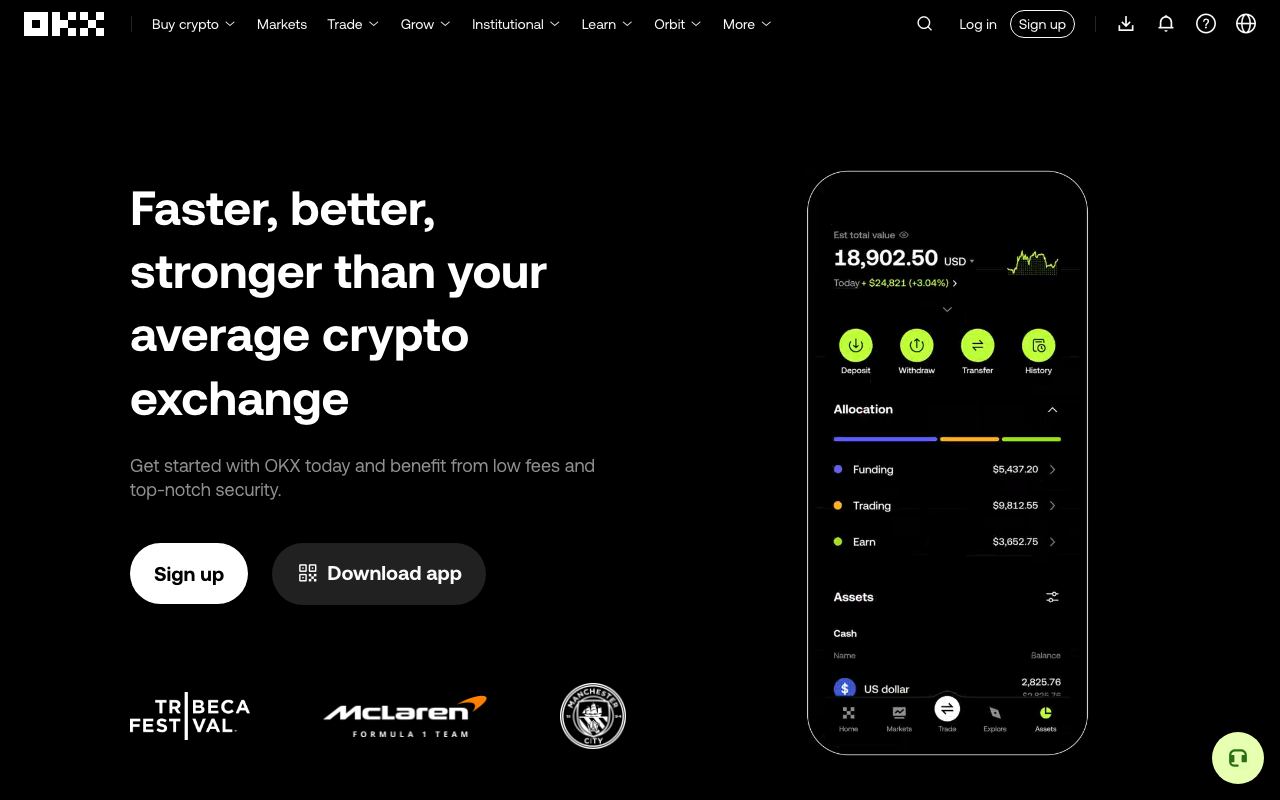
The OKX mobile app has generally held a strong rating on both major app stores — around 4.4 out of 5 on the Google Play Store — reflecting a broad, actively maintained app rather than a bare-bones trading front end; exact figures move over time and should be checked on the current store listing rather than relied on as fixed. Functionally, the app bundles spot and derivatives trading, an integrated Web3/DeFi wallet, staking and earn products, and OKX's DEX aggregator into a single interface, which is unusually feature-dense for a mobile app in this category. That breadth is a strength for an active user who wants CEX and self-custody/DeFi access in one place, but it does add a learning curve: new features and product tabs are added frequently, and the information density on order-entry screens is higher than on a deliberately simplified app like Coinbase's. Push alerts, biometric login and hardware-key 2FA support are present. OKX's app has occasionally been affected by regional app-store availability issues (for example, a brief removal from South Korea's Google Play Store in early 2026 tied to a local regulatory dispute, subsequently resolved), which is worth knowing if downloading in a market with an uncertain regulatory relationship with OKX.
Customer support
OKX offers 24/7 live chat within the app and website, a large self-serve help centre, and ticket-based email support for issues live chat can't resolve. There is no published guaranteed response-time SLA for free-tier users; VIP tiers generally get a faster, more dedicated support path, which is typical for exchanges at this scale. Public sentiment on OKX support is mixed-to-positive for routine account and trading questions handled through live chat, with the more common complaints — consistent with most large offshore exchanges — concerning slower resolution on funds-related disputes or account-verification edge cases. There is no phone support, which is standard in this industry.
Pros
- Low fees and deep liquidity
- Strong all-in-one app with Web3 wallet
- Wide product range
Cons
- Not available in the US
- Lighter regulation than onshore peers
- Feature-dense for beginners
Who it is for
- Best for: Global traders wanting low fees plus a built-in Web3 wallet.
- Avoid if: You are a US user or want a simple beginner app.
Verdict
A strong low-fee, all-in-one option for global users; not for US traders.
Alternatives
- Binance — Deeper liquidity and a simpler flat-rate fee structure, at the cost of no US access at all.
- Bybit — Similar low-fee, offshore positioning with a stronger derivatives/liquidity reputation but a 2025 security incident on its record.
- Kraken — Far more conservative regulatory footprint and longer breach-free history, with a narrower product range.
User reviews
Real reader reviews — separate from FlixoCrypt's own editorial rating above. Every submission is moderated before it appears here.
Loading reviews…
Write a review
Get notified if OKX has a security incident
Related
OKX FAQ
What is OKX? +
OKX is a large global exchange offering low-fee spot and derivatives trading alongside an integrated Web3 wallet and DeFi access. It supports 320+ assets with competitive maker/taker fees and deep liquidity. It is unavailable in the US and is lighter on onshore regulation than Coinbase or Kraken. KYC is required for most functionality.
Is OKX safe? +
OKX is lightly regulated or non-custodial. No major custody breach; integrated Web3 wallet broadens self-custody options. As with any platform, use strong security and only hold what you need on it.
Does OKX require KYC? +
Yes — identity verification (KYC) is required for most features.
What are OKX's fees? +
OKX fees: maker 0.08% spot, taker 0.10% spot; withdrawals: Varies by asset. Always confirm current fees on the official site, as crypto fees change often.
Is OKX available in my country? +
Available globally, with some regional restrictions. Restricted/excluded: United States. Availability, regulation and tax treatment vary by country. Check your local laws before trading, and confirm current details on the official site. Regional note — India: Indian residents face 30% tax on crypto gains and 1% TDS on transactions above ₹50,000 per the Finance Act 2022.
What is OKX best for? +
Global traders wanting low fees plus a built-in Web3 wallet.
When should you avoid OKX? +
Avoid OKX if: You are a US user or want a simple beginner app.
What are the main pros and cons of OKX? +
Pros: Low fees and deep liquidity; Strong all-in-one app with Web3 wallet; Wide product range. Cons: Not available in the US; Lighter regulation than onshore peers; Feature-dense for beginners.
Is OKX regulated? +
No / limited. Select international licences
When was this OKX review last verified? +
This review was last verified on 2026-06-29 against the official site.
Reviewed by Arjun Mehta
Editorial lead overseeing FlixoCrypt's research, sourcing and verification process
Last verified:
Sources
- OKX — official site — verified